Hair Transplant Service
Hair transplantation is a medical procedure planned for individuals experiencing hair loss, with the primary aim of determining whether the procedure is medically appropriate by evaluating the characteristics of the hair loss, its potential progression, and the individual’s overall health status. This service should not be approached through cosmetic promises or guarantees of aesthetic outcomes; instead, it is framed within the principles of medical suitability, patient safety, and the establishment of realistic expectations.
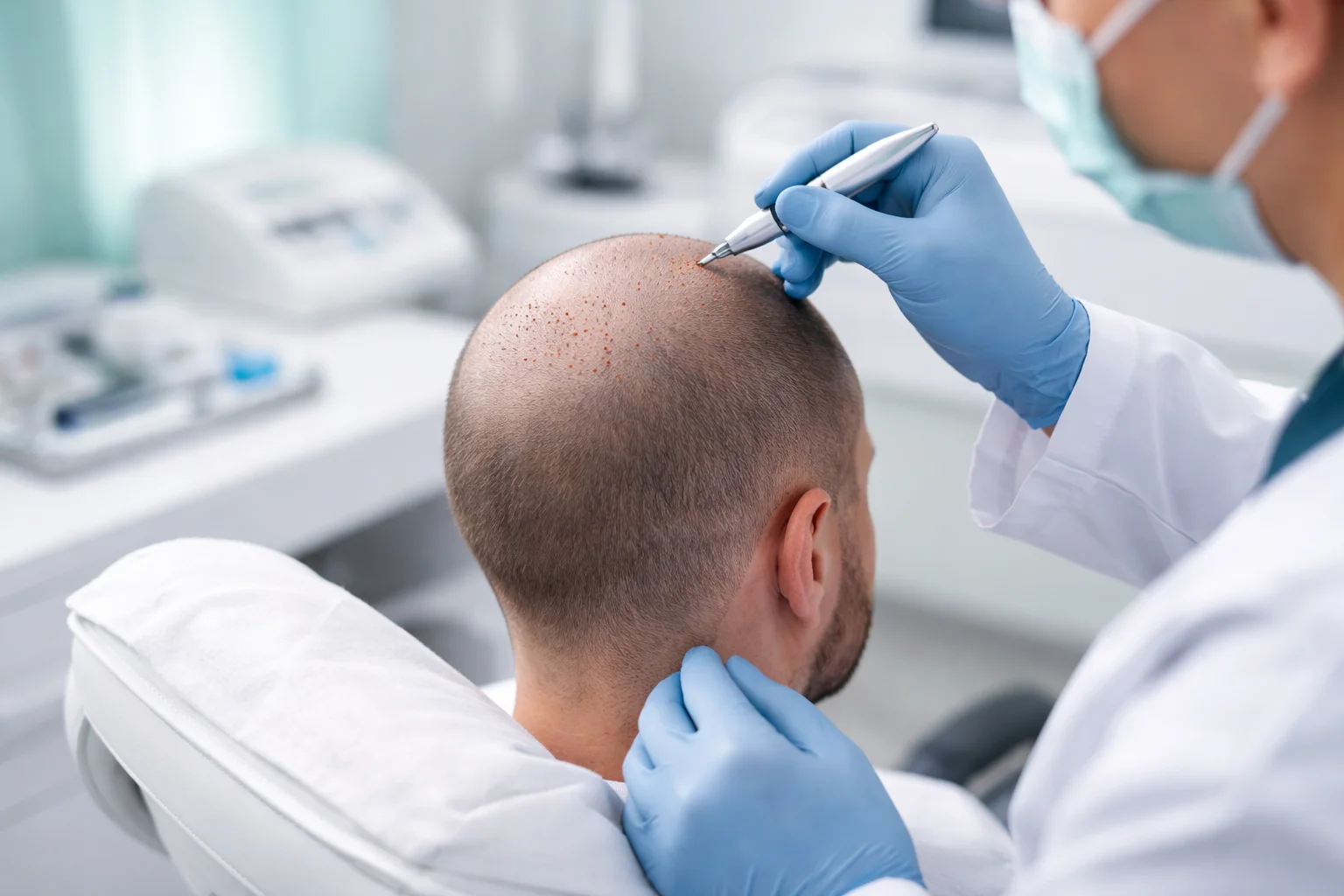
Decisions about hair transplantation are often made by focusing solely on visible thinning areas. In clinical pre-assessment, however, the picture is broader: the type of hair loss, the capacity of the donor area, the condition of the scalp, and the likely course of future loss are evaluated together. For this reason, the process should be considered not as a single, isolated intervention, but as a medical planning process that unfolds over time.
Clinical Pre-Assessment and Common Hesitations
One of the most frequent expectations encountered before clinical evaluation is the assumption that the procedure will result in a “dense and permanent” appearance. In reality, hair transplantation is based on the redistribution of existing hair follicles; creating density beyond the available donor capacity is not medically feasible. This point is addressed explicitly during clinical assessment.
Another common hesitation is the belief that hair transplantation is a one-time procedure with immediate and final results. In clinical practice, follicle adaptation, cyclical hair growth, and the emergence of the final appearance require time. Healing and outcome assessment progress over several months, a temporal aspect that many candidates do not fully anticipate.
The progressive nature of hair loss is also frequently overlooked during decision-making. Clinical evaluation considers not only current thinning areas but also regions that may be affected in the future. This assessment does not aim to promise individual results; rather, it seeks to make long-term limitations and risks visible within a medical framework.
Medical Boundaries for Suitable and Unsuitable Candidates
Hair transplantation is not suitable for every individual. Insufficient donor area, ongoing and uncontrolled hair loss, certain systemic health conditions, or an expectation level that cannot be met within medical limits may lead to postponement or the decision not to recommend the procedure.
Such evaluations are not intended to establish a diagnosis. Their purpose is to protect patient safety and prevent unrealistic expectations. Since outcomes may vary outside clinically predictable boundaries, these limits are clearly communicated.
Clinical Environment, Patient Safety, and Medical Standards
Hair transplantation procedures should be performed in regulated, sterile, and auditable clinical environments. Physical conditions of the clinic, infection control measures, patient monitoring, and emergency preparedness are integral to the procedure. Akl Polyclinic, operating in Istanbul, addresses these processes within the framework of patient safety and established medical standards.
Competence, Experience, and Institutional Responsibility
In clinical practice, the hair transplant process is planned and carried out under the supervision of an experienced medical team. Responsibility throughout pre-assessment, application, and follow-up phases lies with the healthcare institution rather than with an individual practitioner. Common questions and hesitations encountered in clinics are addressed based on accumulated clinical observation over time; however, this communication does not include individual cases or outcome examples.
This information does not replace a clinical examination and does not aim to provide a personal treatment plan.
Pre-Assessment and Information Guidance
Clarifying candidate suitability, expectation boundaries, and how the process progresses over time is often decisive during the decision-making phase. At this point, clinical pre-assessment allows questions to be addressed directly within a medical context. For general information and pre-assessment inquiries, the institution can be contacted via
https://www.aklpoliklinik.com/contact/
This content has been prepared on behalf of Akl Polyclinic, and the responsibility for medical practice and evaluation rests with the relevant healthcare institution.
This content has been reviewed within Akl Polyclinic under specialist physician supervision in the context of clinical medical evaluation.
The text has been prepared in line with current clinical practices and medical protocols; such standards may be updated over time.
The information provided does not constitute diagnosis, personal suitability determination, or individual outcome prediction; it is intended solely for medical information purposes and does not replace personal evaluation.
Requently Asked Questions (FAQ)
Who is a good candidate for a hair transplant, and who may not be suitable?
A hair transplant is typically planned for people with adequate donor hair and a properly evaluated pattern of hair loss. Active scalp conditions, uncontrolled chronic diseases, certain blood-thinning therapies, or insufficient donor capacity may require postponement or may make the procedure unsuitable. Suitability is determined through a medical history review and an in-person assessment. This page is for informational purposes and does not replace a physician’s evaluation.
What is the difference between FUE and DHI, and how is the choice made?
FUE and DHI differ in specific technical steps during graft placement and overall workflow. The most appropriate method depends on the type of hair loss, hair shaft thickness, donor capacity, target density, and hairline design. There is no single “best” method for everyone. The final plan should be personalized after a clinical evaluation.
How many grafts are needed, and how is the graft count determined?
Graft requirements are estimated based on the size of the thinning area (cm²), existing hair density, desired density, and hairline design. Distribution planning may differ between the frontal zone, mid-scalp, and crown. Protecting donor capacity is essential for long-term outcomes. The most accurate estimate comes from an in-person exam and photo-based analysis.
Does the procedure hurt, and how is anesthesia applied?
Hair transplantation is usually performed under local anesthesia, aiming to minimize discomfort during the procedure. The anesthetic injections may cause brief, temporary discomfort. Mild soreness or tightness can occur in the first days afterward, and following the physician’s aftercare and medication plan improves comfort. Pain levels vary from person to person.
What is the recovery process like, and what should I pay attention to in the first 10 days?
In the early days, protecting the recipient area from impact and following the recommended washing protocol are important. Scabs should not be forced; scratching, friction, or using unapproved products can negatively affect healing. Activities such as intense exercise, heavy sweating, sauna/steam rooms, and swimming are commonly restricted for a period defined by the clinic. Exact timelines depend on the individual and the technique used.
What is shock loss, and when does new hair start to grow?
In the first weeks, scabbing and temporary shedding known as “shock loss” can occur and may be considered normal in some patients. Growth often starts around month 3, becomes more noticeable by month 6, and the final appearance commonly stabilizes toward month 12. Growth speed depends on hair characteristics, aftercare adherence, and individual healing differences. Expectations should be personalized after evaluation.
What are the risks and possible side effects?
As with any medical procedure, hair transplantation carries risks such as swelling, redness, infection, folliculitis, temporary numbness, lower-than-expected density, or uneven growth. Risks can be reduced through proper planning, sterile technique, careful donor management, and adherence to aftercare instructions. If unexpected symptoms occur, patients should contact the clinic promptly. Risk profiles vary by individual.
Do smoking and alcohol affect results?
Smoking can negatively impact circulation and wound healing, so many clinics recommend restrictions before and after the procedure. Alcohol may increase swelling or bleeding tendency in some individuals. The best approach depends on health status and any medications in use and should be guided by the physician. Following clinic instructions supports better outcomes.
How is the hairline planned, and what determines a natural look?
A natural hairline is planned based on facial proportions, age, current hair characteristics, and the likelihood of future hair loss. Key factors include graft angle and direction, frontal density, and smooth transitions. Overly straight or artificial hairlines can lead to an unnatural appearance. Planning should be done on a personalized basis during consultation.
Is one session enough, or might a second session be needed?
Whether one session is sufficient depends on the size of the thinning area, target density, and donor capacity. Some patients achieve satisfactory results in one session, while larger areas or higher density goals may require an additional session. Avoiding over-harvesting is important to protect the donor area long term. The final decision is made after evaluation and planning.